

There is no cheaper way to buy reliability than this: take the design you already have and run its parts further below their ratings. No redundancy, no exotic technology, no late-programme redesign. Derating is a decision taken at part selection, cheap to take, if not to verify, and it keeps paying for the entire service life of the fleet.
It is also routinely done badly: as folklore instead of policy, applied blindly where margin costs real money, or skipped exactly where the physics would have rewarded it most. This article is about doing it deliberately.
What derating actually buys
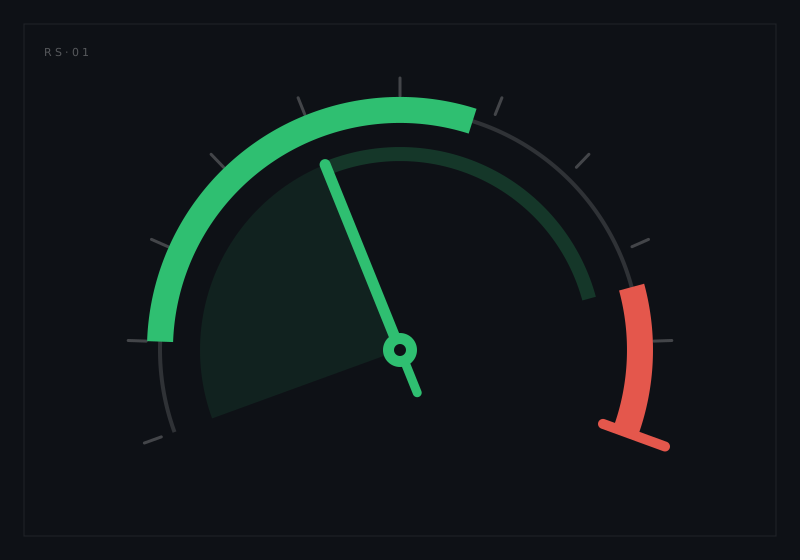
Every component carries ratings: maximum voltage, current, power, junction temperature, mechanical load. A rating is the boundary of the manufacturer's promise, the edge of the envelope inside which the datasheet's behaviour holds, not a recommendation to operate there. Derating is the deliberate decision to hold applied stress a defined distance below that boundary: a resistor run at half its rated power, a capacitor at two-thirds of its rated voltage, a transistor with its junction held far below the absolute maximum.
The margin buys two different things, and both matter.
The first is life. The failure mechanisms that dominate electronics (electrochemical degradation, diffusion, dielectric wear-out, electromigration, contact erosion, fatigue) are stress-driven processes. Their rates rise steeply with temperature, voltage, current density, or load. Pull the operating point down and every one of those clocks runs slower.
The second is robustness to what you did not predict. Real circuits see tolerance stack-ups, supply transients, thermal-map errors, and duty cycles the requirements never mentioned. A part operating at 95% of its rating has no room for any of that. A derated part absorbs the surprise instead of failing from it.
The arithmetic is on your side
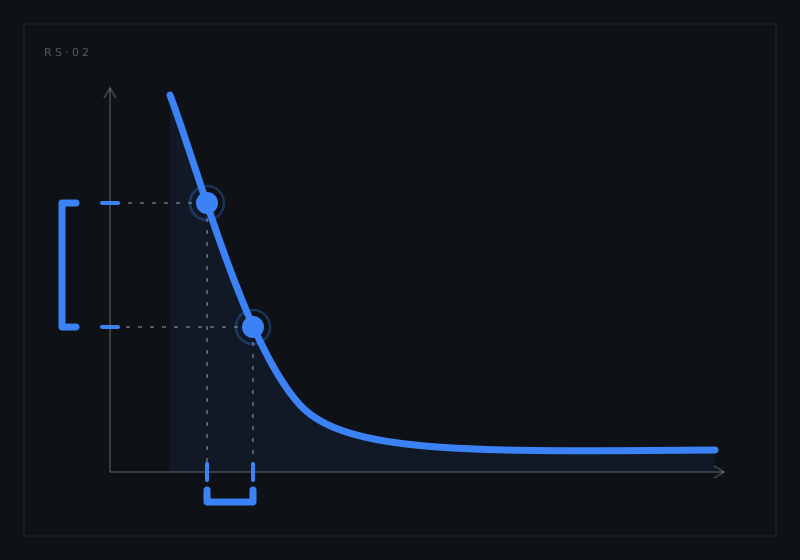
The reason derating is such a bargain is that stress–life relationships in electronics are not linear. They are exponentials and steep power laws, which means a modest move in stress buys a disproportionate move in life.
Temperature is the canonical case. Chemically-driven degradation follows Arrhenius behaviour: reaction rate scales exponentially with temperature. The familiar rule of thumb: every 10 °C of reduction roughly halves the degradation rate, is only an approximation, and the true acceleration depends on the activation energy of the specific mechanism. But the shape is real, and it is why aluminium electrolytic capacitor manufacturers publish endurance formulas of exactly this form: run the part cooler and the rated life multiplies. Voltage stress on dielectrics behaves similarly, following power laws with large exponents, and mechanical fatigue does the same through the S–N curve.
The prediction models the discipline already uses reflect this directly. The part-stress models in MIL-HDBK-217 take stress ratios and temperatures as inputs, and FIDES is built around the physical stresses a part experiences in its mission profile. Derate a design and its predicted failure rate falls, not as a bookkeeping trick, but because the models encode the same physics. The improvement then propagates to everything that consumes those failure rates: the reliability allocation, the FMECA criticality numbers, the spares calculation.
One honesty note: a prediction is a model output, not a warranty. Derating genuinely slows real mechanisms; the prediction merely estimates by how much. Treat the falling number as a comparison tool between design options, which is what it is good at.
Where the margin matters most
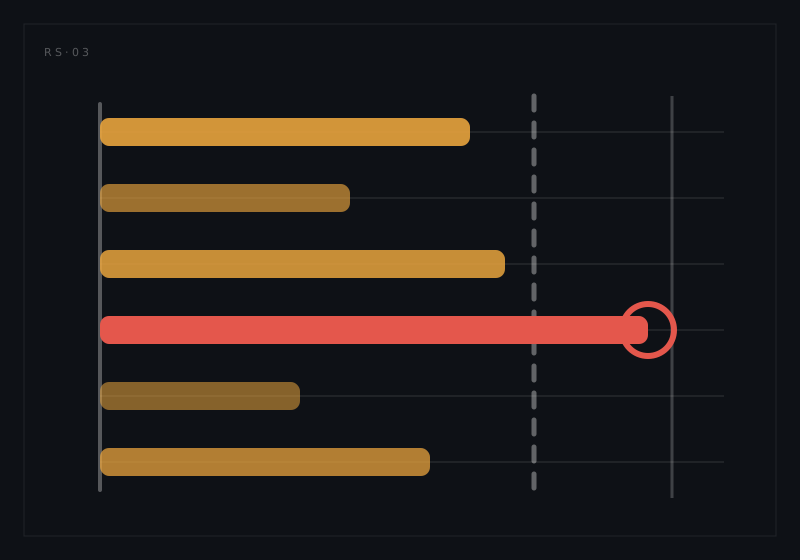
The payoff is not uniform across the bill of materials, and mature derating practice concentrates where the physics concentrates.
- Electrolytic and tantalum capacitors. Voltage, temperature, and ripple current all drive wear-out. Tantalum capacitors in low-impedance circuits are the classic case: common practice holds them to around half their rated voltage because of their sensitivity to surge current.
- Power semiconductors. Junction temperature is the dominant stress, which makes derating inseparable from thermal design; the margin is bought with heatsinking, airflow, and layout as much as with part selection.
- Resistors. Datasheet power-derating curves fall off above a temperature knee; a resistor "within rating" at 25 °C ambient may be far outside it in a sealed enclosure in the sun.
- Optoelectronics. LED and optocoupler output degrades gradually with drive current; current margin directly slows the fade.
- Contacts. Relays, switches, and connectors erode with switched current and load type; inductive loads punish contacts far harder than the resistive rating suggests.
None of this is new knowledge, which is precisely the point. The space sector codified it long ago: ECSS-Q-ST-30-11C exists to standardise derating of EEE components across European space programmes, and most defence primes maintain their own derating manuals. The specific limits differ; the structure is always the same: a rule per part family per stress type, applied at part selection, verified by analysis.
When derating is not free
The title of this article says cheapest, not free, and the difference is where engineering judgement lives.
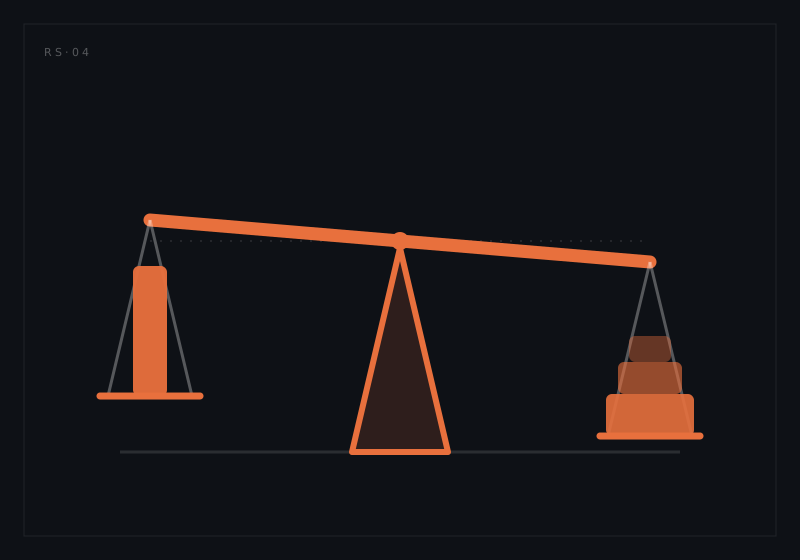
Margin has physical costs. A capacitor derated harder is a bigger capacitor; a power stage derated hard means larger magnetics and more copper; holding a junction cooler means more heatsink. That is board area, mass, and unit cost, and in defence and aerospace programmes, mass is often the most contested budget on the project. Blanket 50%-everything derating spends that budget indiscriminately, which is how derating policies lose credibility with design teams.
A few parts genuinely dislike being under-loaded. Relay and switch contacts are the standing example: they need a minimum wetting current to keep their surfaces clean, and a contact derated far below it fails more, not less. Derating rules that acknowledge these floors get followed; rules that pretend margin is always monotonic get quietly ignored.
And derating only slows the mechanisms driven by the derated stress. It does nothing for vibration-driven solder fatigue, a workmanship escape, or a counterfeit part. It is one lever in the reliability programme, not the programme.
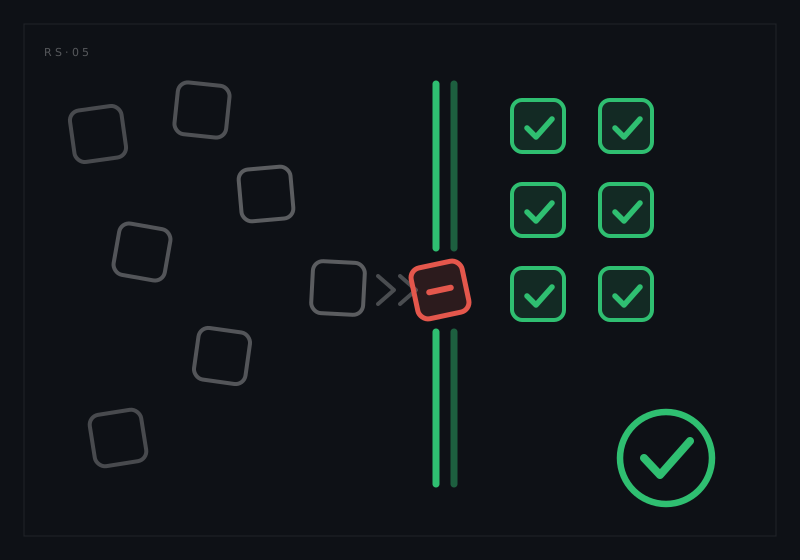
The practical resolution is to scale the rules by criticality: strict limits where a failure propagates into safety or mission loss, standard limits elsewhere, and a deviation process (justified, reviewed, recorded) for the places where the rule and the physics disagree.
From habit to policy
Programmes that benefit from derating, rather than merely talking about it, have two things the others lack: a written policy and a verifiable work product.
The policy is a table: part family, stress type, limit, and the conditions under which the limit tightens. The work product is the part-stress analysis: every line of the BOM, the applied stress from the electrical design and the thermal analysis, the rating from the component data, the ratio between them, and a pass, fail, or approved-deviation verdict. It is the same stress data the reliability prediction consumes, which is exactly why the two analyses belong together rather than in separate spreadsheets.
The failure mode of this work product is staleness. A derating analysis is a snapshot of a moving design: an engineering change swaps a part, a new thermal analysis revision raises a local temperature, a supplier substitution changes a rating, and the spreadsheet silently stops describing the product. The analysis that impressed the design review can be quietly wrong by qualification test.
How RAMSynapse approaches this
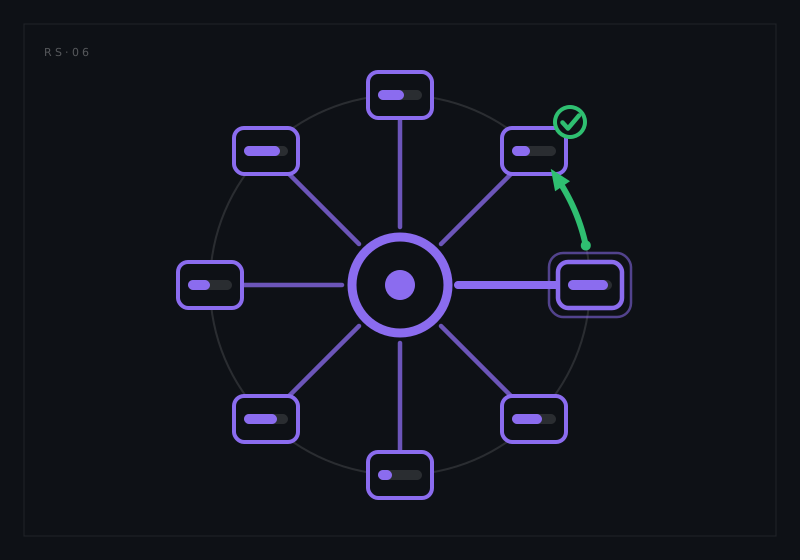
We built RAMSynapse around a live registry precisely because of failure modes like the stale derating spreadsheet. The part list arrives from PLM through a maintained integration rather than a one-off export, stress and temperature values live on the same registry the failure-rate predictions consume, and derating limits are evaluated against those values continuously. When a change order swaps a component or a thermal revision moves a temperature, the affected stress ratios recompute and any new violation is flagged, the derating analysis stops being a snapshot and becomes a property of the current design.
The same registry values feed the prediction models, so the failure rates in the allocation and the FMECA always reflect the stresses the derating analysis verified. One set of numbers, one product definition, every analysis pointed at it.
That is the quiet promise of derating done properly: the cheapest reliability you will ever buy, provided you can prove today, not at last year's design review, that you are still buying it.
Curious what a live part-stress analysis looks like on a real BOM? Request a walkthrough.