

An item fails and comes off the equipment. Somebody has to decide what happens next, and there are only two answers: throw it away and fit a new one, or repair it somewhere. If repair, the second question follows immediately: at the equipment, at a workshop near it, or at one central facility.
That is the whole of a level of repair analysis, and it sounds like a small question until the arithmetic is written down. Repairing an item anywhere means owning the capability to repair it there: the test equipment, its calibration, the trained people, the manuals, the spares to cover the turnaround. The capability is bought per site and used per failure, so the answer depends on how often the item fails, how many sites there are and what the capability costs, and not much at all on how hard the repair is.
Two decisions, one grid
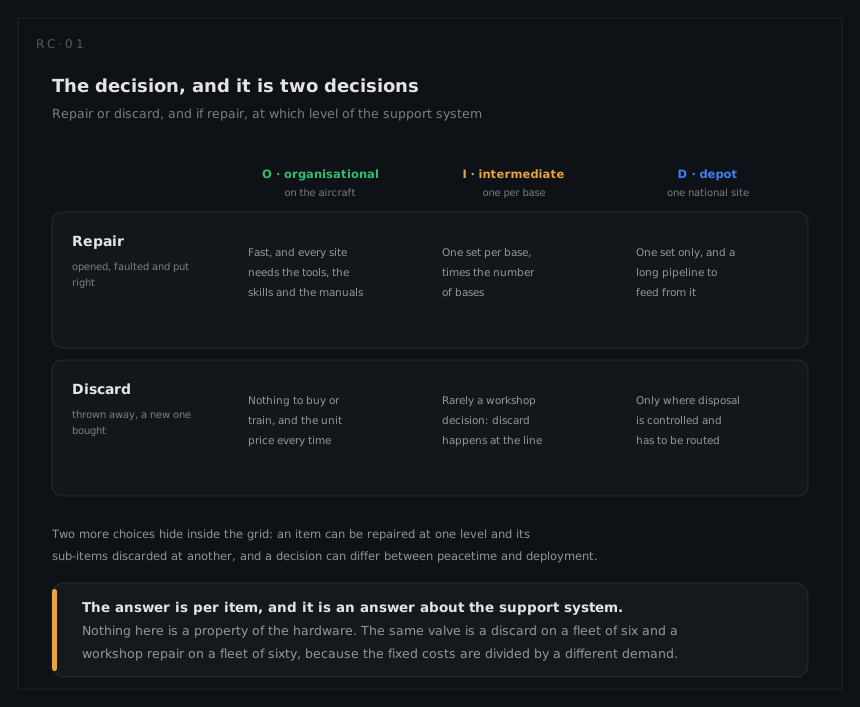
The levels have names, and the abbreviations are used everywhere in this field without explanation:
| Level | Sites | Typical work | |
|---|---|---|---|
| O | Organisational, sometimes unit or first line | Wherever the equipment operates | Remove and replace, servicing, checks |
| I | Intermediate, sometimes field or second line | One shop per base | Bench repair of what O level removed |
| D | Depot, sometimes overhaul or third line | One national site, or the supplier | Heavy rigs, certified benches, release authority |
The mechanism behind them is one sentence: each level down is fewer sites, longer pipelines and cheaper capability per repair. Not every programme has all three; two-level support, organisational and depot with no intermediate shop, is now common. How many levels exist is part of the maintenance concept and is an input here; which level each item lands at is the output.
Non-economic first, then the money
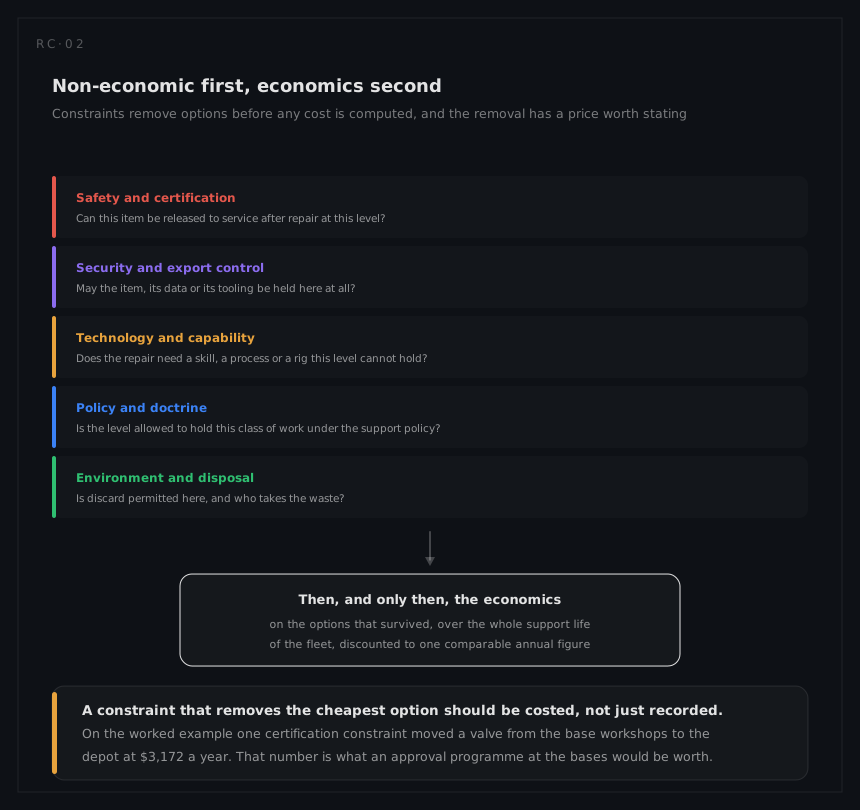
The published decision logic is explicit about the order, and about the fact that both evaluations happen. Preempting factors are identified first; a non-economic evaluation addresses the factors that override cost and is performed without consideration of costs; an economic evaluation is performed regardless; and the recommendation resolves to discard, or to repair at exactly one level.
The last clause of that guidance is the one practitioners under-use: the conclusions of the non-economic evaluation should still be given an economic value by the economic analysis that follows. A constraint that sends an item to the depot is a decision with a price, and the price is what a programme to relax the constraint would have to beat.
Where the discipline comes from, and where it went
The lineage is worth knowing precisely, because the document most people cite has been cancelled twice over.
| Document | Status |
|---|---|
| MIL-STD-1390D, Level of Repair Analysis (LORA), 19 January 1993 | Cancelled. Revision C, 8 July 1988, was titled Level of Repair (LOR) and was Navy-scoped; the LORA wording arrives at revision D |
| MIL-PRF-49506, Logistics Management Information, 1996 | Superseded 1390D, then cancelled itself on 31 March 2011 |
| SAE GEIA-STD-0007, Logistics Product Data | Where the data requirements went |
| SAE AS1390, adopted for DoD use 8 October 2014; current revision AS1390A, 4 April 2023 | The active LORA standard |
| MIL-HDBK-1390, 29 January 2015 | Guidance for AS1390, explicitly non-mandatory |
| TA-STD-0017, Product Support Analysis, DoD-adopted 11 June 2013 as a TechAmerica standard, and again on 22 August 2024 as an SAE one | Carries LORA as a sub-activity of its evaluation-of-alternatives activity |
| MIL-HDBK-502A, Product Support Analysis, 8 March 2013 | Guidance; its LORA appendix states that it contains no requirements |
AS1390 is deliberately process-oriented rather than model-prescriptive: it sets out activities, from programme strategy and planning through input data compilation to performing the evaluation and using the results, and recognises three kinds of evaluation, economic, non-economic and sensitivity. It does not tell you which cost model to use, which is why every organisation's LORA looks slightly different and why the assumptions matter more than the arithmetic.
UK practice puts the same analysis inside its supportability analysis task set, as a sub-task of the evaluation of alternatives and trade-off group, and states the same rule in one sentence: the repair level decision will normally be based on economic factors unless there are overriding operational requirements. The requirement to do it comes from the defence standard for integrated logistic support; the choice of method does not.
What it is not
- It is not a maintenance concept. The concept says how many levels exist and where; the analysis populates it item by item. Running the analysis before the concept is fixed produces answers to a question nobody asked.
- It is not a repair cost comparison. The quantity compared is the annual cost of owning the capability, fixed costs included. On the worked example the repairs themselves are seventeen per cent of the cost of the option they belong to, and the capability is the other eighty-three.
- It is not spares optimisation. The two are coupled, because the repair level sets the turnaround time and therefore the pipeline, and there are published formulations that optimise both together. A sequential analysis, level first and stock second, is the normal practice and it is an approximation.
- It is not permanent. Fleet size, usage, prices and observed failure rates all move, and each of them can move an item across a boundary.