

Reliability is the R that gives RAMS its first letter, and the property every other letter leans on. Availability is unreachable without it, maintainability exists because it is imperfect, and safety analysis spends most of its time asking what happens when it runs out. Yet of the four, reliability is the one most often treated as something a product simply turns out to have, discovered in service, argued about in warranty meetings, rather than a property that was quietly decided years earlier by a thousand small design choices.
This topic is the theory backbone for the reliability methods in RAMS Core. The method pages (Reliability Allocation, Reliability Prediction, derating, block diagrams, fault trees, growth, life data) each teach one analysis end to end. This one teaches what they all share: what reliability formally is, the mathematics that describes it, how it behaves when components are wired into systems, and how a programme designs it in rather than hoping for it.
What reliability is
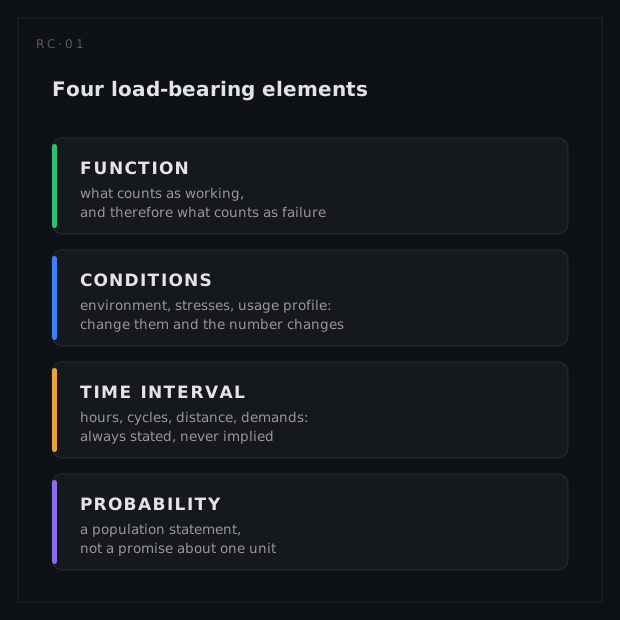
The international dependability vocabulary (IEC 60050-192) defines reliability as an ability: to perform as required, for a given interval, under given conditions, and keeps the quantified sense (reliability as a probability measure) as a separate, paired concept. The classic US military definition (MIL-STD-721C) leads with the probability language directly: the probability that an item performs its intended function for a specified interval under stated conditions. Read together they carry four elements, and every one of them is load-bearing:
| Element | What it pins down | What happens if you drop it |
|---|---|---|
| Function | What counts as working, and therefore what counts as failure | Any anomaly can be argued in or out of the failure count |
| Conditions | Environment, stresses, usage profile | A ground-benign number gets quoted for a vibrating, hot, humid installation |
| Time interval | Mission length, calendar life, cycles, demands | "99% reliable" means nothing; 99% per hour and 99% per 20-year life differ by orders of magnitude |
| Probability | Reliability is a population statement, not a promise about one serial number | Point predictions get treated as guarantees |
Two consequences follow. First, reliability is always conditional: change the mission profile or the environment and the number changes with it, which is why every reliability figure should travel with its conditions attached. Second, failure needs a definition before reliability can have one. Programmes that skip the failure-definition step discover it later, in the argument about whether an intermittent fault, a degraded output, or an operator workaround belongs in the count.
It also pays to keep reliability distinct from its neighbours. Quality is conformance at delivery: the product matches its specification at time zero. Reliability is quality's behaviour over time; a unit can pass every inspection and still fail in month three. And within reliability itself, programmes usually track two flavours: basic reliability counts every failure because every failure drives logistics, spares, and maintenance burden, while mission reliability counts only the failures that abort or degrade the mission, which is why redundancy improves mission reliability while making basic reliability slightly worse (more parts to fail).
Why it matters
Unreliability is expensive in a way that is easy to underestimate, because its costs arrive late, spread across budgets, and rarely carry the name of the design decision that caused them. By the time a fleet is in service, the cost of a failure mode includes the repair itself, the downtime, the spares pipeline sized to feed it, the technicians trained to fix it, the missions or production it interrupted, and the reputation of the product that carried it. Almost all of that was fixed long before the first delivery: the stress margins, the part choices, the redundancy topology, and the thermal design were decided on paper, cheaply, when changing them cost a drawing revision instead of a retrofit campaign.
| When a failure's cause is decided | When its cost is paid | The asymmetry |
|---|---|---|
| Concept and architecture (redundancy, technology choice) | Years later, across the whole fleet life | Cheapest to change, most expensive to ignore |
| Detail design (stresses, margins, parts, thermal) | Warranty period onward | A derating fix costs a resistor; a field fix costs a campaign |
| Manufacturing (process escapes, workmanship) | Early life, infant mortality | Screening catches some; the escape rate ships |
| Operation and maintenance (misuse, induced failures) | Immediately | The one place cost and cause meet at the same time |
That asymmetry is the business case for the whole discipline. Reliability engineering is the set of methods that move the discovery of failure backwards in time: from the field to the test rig, from the test rig to the analysis, from the analysis to the requirement. Every method in the toolkit (the methods chapter maps them) is a different way of paying a little now instead of a lot later.
Reliability among R, A, M and S
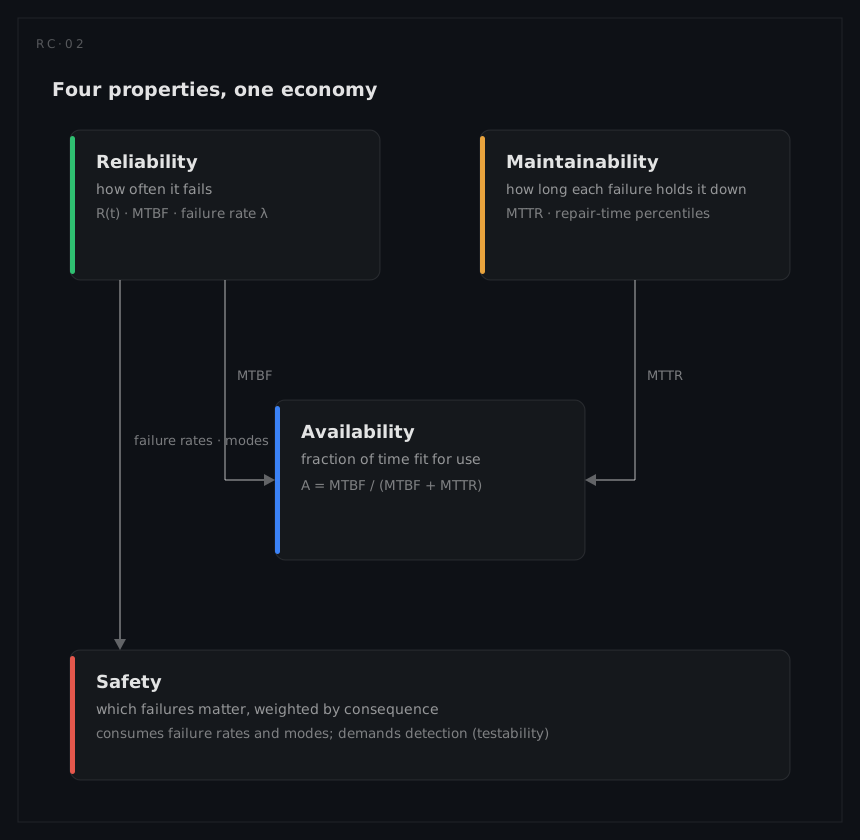
The four RAMS properties are not siblings so much as a small economy, with reliability as its primary producer:
- Availability is the fraction of time a system is fit for use, and in its steady-state form it is set entirely by the failure and repair balance,
A = MTBF / (MTBF + MTTR). Reliability controls the first term, maintainability the second, and the same availability target can be met by failing rarely or by recovering fast. Which mix is right is an economic and operational question, not a mathematical one. - Maintainability exists because reliability is finite. How quickly a failure can be diagnosed, reached, and repaired is a designed property with its own measures (MTTR, repair-time percentiles) and its own analyses, and it trades directly against reliability in the availability equation.
- Safety overlaps reliability but is not the same property. Reliability counts all failures; safety cares about the subset with dangerous consequences, weighted by severity. A system can be highly reliable and unsafe (it rarely fails, but when it does, the failure is catastrophic and undetected), or unreliable and safe (it fails often, always to a benign state). Safety analyses such as fault trees and functional hazard analysis consume reliability numbers as inputs, but ask a different question of them.
- Testability is the property that lets both maintainability and safety do their jobs: a failure that cannot be detected cannot be repaired promptly, and a dangerous failure that hides defeats the safety argument.
This is why RAMS is practised as one discipline rather than four. An allocation that tightens a reliability budget loosens the maintainability one; a redundancy added for mission reliability adds failure modes for the safety analysis to examine; a derating decision changes the prediction that feeds all of them. The live module ring is built around exactly this traffic: the quantities that flow between the analyses are the connections between the four properties, made explicit.
Where the discipline came from
Reliability engineering has a precise birthplace: military electronics in the decade after the Second World War. Vacuum-tube equipment of the period spent a large share of its life broken, and the cost of keeping it alive (spares, technicians, downtime) was visibly out of proportion to the cost of buying it. The US Department of Defense chartered the Advisory Group on Reliability of Electronic Equipment (AGREE) in 1952, and its 1957 report became the discipline's founding document: it argued that reliability must be specified quantitatively, allocated to subsystems, designed in, and demonstrated by test, a programme structure that is still recognisable in every reliability standard in force today.
| Era | What changed | What it left behind |
|---|---|---|
| 1950s | AGREE: reliability becomes a specified, allocated, tested requirement | The programme structure; the AGREE allocation method |
| 1960s–1980s | Handbook prediction matures (MIL-HDBK-217 lineage); FMEA, FTA, growth models formalised | The method toolkit; MIL-STD-785B's task catalogue |
| 1990s | Acquisition reform cancels or demotes many military standards; commercial models (Telcordia and others) spread | A more fragmented but more physics-aware landscape |
| 2000s onward | Physics-of-failure, GEIA-STD-0009's outcome-based programme standard, cheap field telemetry | Emphasis shifts from predicting failure to engineering it out and measuring it live |
The arc matters because the vocabulary still carries it. The exponential-heavy mathematics, the MTBF fixation, the environment letters in prediction handbooks: all of it is inherited from an era of fielded electronics failing at roughly constant rates. Modern practice keeps those tools where they fit, and reaches for life-data analysis, physics-of-failure, and growth testing where they do not. The chapters that follow take the theory in that order: first the mathematics as it is, then where its assumptions hold, then what to do when they break.