

Every system that can fail poses a second question the moment it does: how long until it works again? Maintainability is the property that answers it. Where reliability governs how often a system goes down, maintainability governs how long it stays down, and the two multiply into every operational outcome a customer actually experiences: availability, mission capability, cost per operating hour, the size of the spares shelf, and the number of technicians on the payroll.
Maintainability is also the most underrated member of the RAMS quartet, because it looks like an operations problem and is in fact a design property. Whether a failed unit is swapped in twelve minutes or dismantled for four hours was decided years before the failure: by where the connectors sit, whether the built-in test names the failed card or a cabinet, whether the fastener needs a special tool, and whether the manual matches the hardware. This topic covers the theory of that property: how repair time is defined and measured, how it distributes and rolls up, and how it is designed in rather than discovered.
What maintainability is
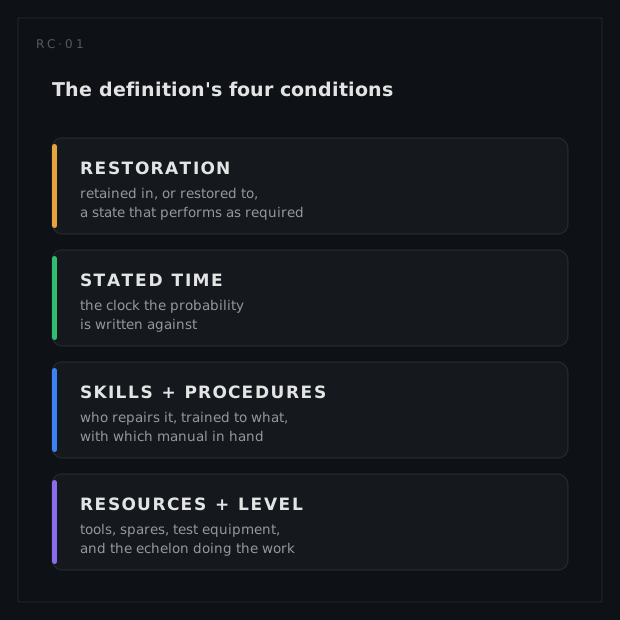
The international dependability vocabulary (IEC 60050-192) defines maintainability as an ability: to be retained in, or restored to, a state to perform as required, under given conditions. The classic US military definition (MIL-STD-721C) makes the quantitative content explicit: the measure of an item's ability to be retained in or restored to specified condition when maintenance is performed by personnel with specified skill levels, using prescribed procedures and resources, at each prescribed level of maintenance. In quantified form, maintainability is a probability with a clock on it: the probability that a failed item is restored within a stated time.
The conditions clause deserves the same respect as reliability's. A repair time is only meaningful against a stated maintenance environment:
| Element | What it pins down | What happens if you drop it |
|---|---|---|
| Restoration, not just repair | Retained in (preventive) or restored to (corrective) working state | Preventive downtime quietly escapes the analysis |
| Stated time | The clock the probability is written against | "Easy to maintain" becomes an adjective instead of a number |
| Skills and procedures | Who repairs it, trained to what level, with which manual | Depot-expert times get quoted for a field technician |
| Resources and level | Tools, test equipment, spares, and the echelon doing the work | A number measured at the bench gets promised for the flight line |
Two sibling terms need separating early. Maintenance is the activity: the inspections, servicing, and repairs performed on the system. Maintainability is the design property that determines how much that activity costs in time and labour. A programme cannot fix poor maintainability with more maintenance; it can only pay for it, forever, in downtime and man-hours. And within the property itself, two branches carry different mathematics: corrective maintainability (restoring after failure, the random-clock branch) and preventive maintainability (scheduled retention work, the planned-clock branch). Both consume the same design features: access, modularity, diagnosis.
Why it matters
Maintainability's costs and benefits arrive through three channels, and all three compound over decades of service:
- Downtime. For any repairable system, availability is set by the balance of failure and restoration. A design that halves repair time buys the same availability improvement as one that doubles reliability, and it is frequently the cheaper of the two purchases, because repair time responds to layout and diagnostics decisions that cost little at the drawing stage.
- Labour. Every hour of maintenance is a paid hour, multiplied across the fleet and its life. Maintenance man-hours per operating hour (MMH/OH) is tracked as a first-class requirement in defence programmes precisely because the labour bill over a platform's life routinely dwarfs its purchase price.
- Error. Hard-to-maintain systems are not just slow to fix; they are fixed wrong more often. Awkward access, ambiguous diagnostics, and reassembly traps convert maintenance actions into new failure causes, a coupling the reliability analysis then inherits (maintenance-induced failures are a classic common-cause channel).
The asymmetry that justified reliability engineering applies here with equal force: the causes of long repairs are locked in early and paid for late. By the time a fleet exists, the connector behind the hydraulic manifold, the fault code that points at three cards instead of one, and the calibration that needs a depot jig are all facts of life. The discipline exists to surface those costs while they are still drawing-board decisions.
Maintainability among R, A, M and S
Maintainability's relationships to its three siblings are tight and quantitative:
| Relationship | The coupling |
|---|---|
| With reliability | Failure rate sets how often the repair clock starts; reliability improvement and repair-time improvement are exchangeable currencies for availability, traded explicitly during allocation |
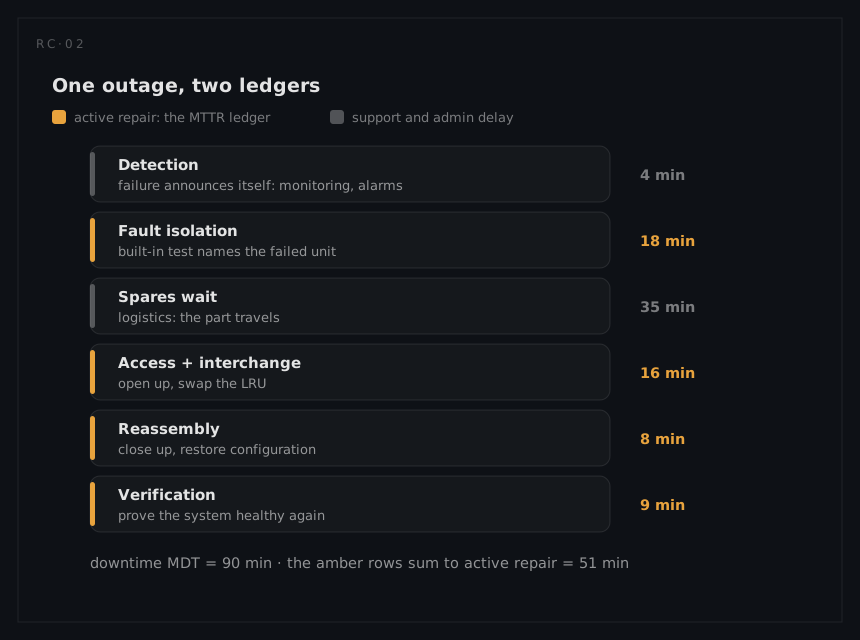
| With availability | Steady-state availability is the balance A = MTBF / (MTBF + MTTR); the operational form replaces MTTR with full downtime including logistics. Availability is where R and M meet, and it gets its own topic |
| With safety | Dangerous failures must be found and fixed before they pair with a second failure; inspection intervals and repair priorities are safety parameters, and maintenance error is a hazard source of its own |
| With testability | The enabling property: a failure that cannot be localized cannot be repaired quickly. Fault detection and isolation coverage bounds every downstream repair-time number |
The last row is worth underlining. In modern electronics-dense systems the diagnosis step, not the wrench work, dominates corrective time, which makes testability the strongest single lever on maintainability. A built-in test that isolates to one replaceable unit turns a repair into a swap; one that isolates to a three-unit ambiguity group turns it into an experiment.
Where the discipline came from
Maintainability crystallised as a named engineering discipline in the same post-war military-electronics crucible as reliability, roughly a decade behind it. The pattern of institutionalisation repeated: quantitative requirements first, then prediction methods, then demonstration tests, then programme standards. US military documents of the 1960s gave the discipline its durable vocabulary (MTTR, the maintainability function, prediction and demonstration per the MIL-HDBK-472 and MIL-STD-471 lineage), and MIL-HDBK-470A consolidated the design-for-maintainability practice in the late 1990s as the standards reform converted requirements documents into guidance handbooks.
The second formative current came from the airlines rather than the military. The reliability-centred maintenance work of the 1970s (Nowlan and Heap's landmark study for the US Department of Defense, distilled from airline scheduled-maintenance experience) overturned the assumption that more preventive maintenance is always better, showing that for most complex-equipment failure modes, scheduled overhaul does nothing for reliability and sometimes harms it. That result reshaped what the maintenance side of the discipline asks for: not maximum maintenance, but the right task for each failure mode's consequences, which is exactly the question RCM formalises. The chapters that follow build the quantitative core first: the repair-time mathematics, then how it composes at system level, then the design and programme machinery, then the toolkit map.