

Maintainability's toolkit is smaller than reliability's but more interlocked: every method in it consumes the same failure-mode inventory, and each one's output is another's stated condition. This chapter is the map: what each analysis answers, how they chain, where the RAMSynapse platform stands, and how the emphasis shifts by industry.
The maintainability toolkit
| Method | The question it answers | Typical phase | Read more |
|---|---|---|---|
| Maintainability Prediction | What MTTR and percentiles does this design imply, before hardware exists? | Design | Full topic published |
| Maintenance Task Analysis | What does each maintenance action actually take: steps, time, people, tools, spares? | Design onward | Full topic published |
| Level of Repair Analysis | Where should each item be repaired, or should it be discarded? | Design and support planning | Full topic published |
| Reliability Centred Maintenance | Which preventive task, if any, does each failure mode deserve? | Design and operations | Full topic published |
| Testability Analysis | What fraction of failures does the built-in test detect, and to how tight a group does it isolate? | Design | Full topic published |
| FMECA | The shared input: what fails, how, how often, with what effect? | Design | Full topic published |
| RBD availability modelling | What availability do these failure and restoration rates deliver through this architecture? | Design | Full topic published |
| FRACAS | Are field repairs behaving as predicted, and are the exceptions being closed out? | Test and field | Full topic published |
Two structural notes. The FMEA appears in this table even though it is a reliability-and-risk method, because it is maintainability's raw material: the failure-mode list with rates and effects is what testability coverage is computed against, what repair tasks are enumerated for, and what RCM's consequence questions interrogate. And maintainability allocation, the flow-down of MTTR and Mmax budgets through the product structure, is practised inside the prediction and task-analysis loop rather than as a standalone method; it mirrors reliability allocation with repair-time budgets instead of failure-rate budgets.
How the methods chain together
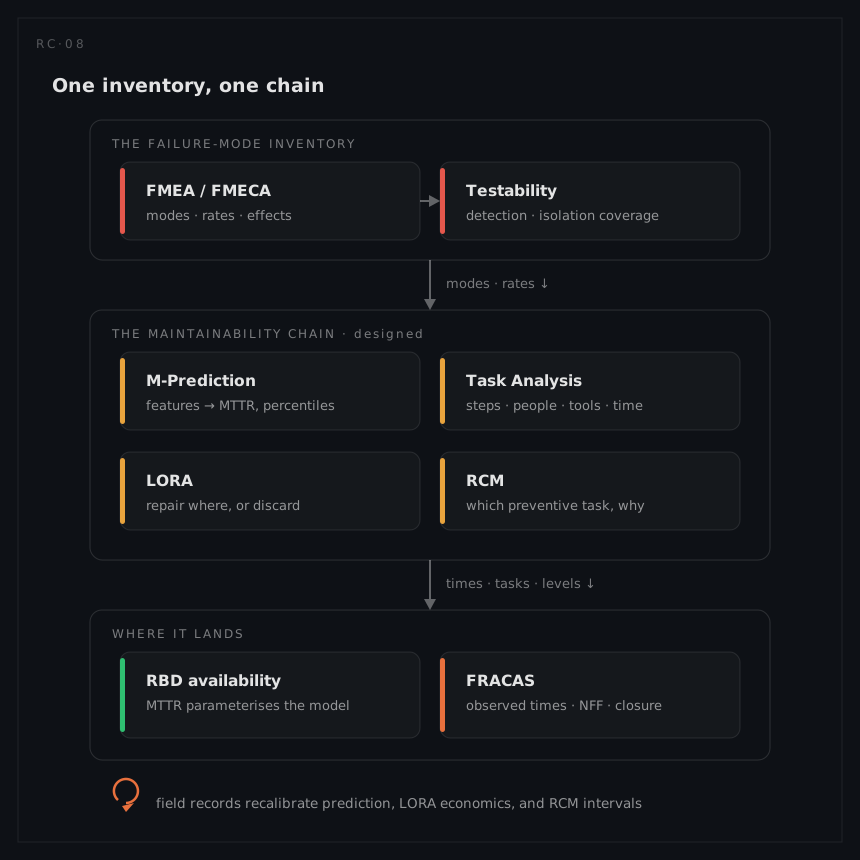
Read as quantities in motion, the chain runs:
- The inventory flows in. The FMEA hands its failure modes and rates to the testability analysis, which returns detection and isolation coverage: the numbers that scope every diagnosis time downstream.
- Features become times. Maintainability prediction scores the design's access, interchange, and verification features per failure mode, weights by the predicted rates, and rolls up MTTR and percentiles against the allocated budgets. Task analysis deepens the important actions into step-level detail: people, tools, spares, elapsed time.
- Structure gets decided. LORA takes the repair times, spares costs, and echelon options and outputs the maintenance concept's economics: what is repaired where, what is discarded. RCM takes the modes and consequences and outputs the preventive task set and intervals.
- The results land. Restoration times and detection intervals parameterise the availability models; task sets and levels size the support system; and the field's maintenance records flow back through FRACAS as observed times, no-fault-found rates, and task findings that recalibrate every step above.
The chain's failure mode is the same as reliability's: handoffs. A LORA run on last quarter's repair times, a prediction weighted by a stale failure-rate table, an RCM interval never revisited after the field data arrived: each is a quiet divergence between the analyses that the next design review inherits as fact.
Where RAMSynapse stands
The built modules cover this chain's front end today: FMECA carries the failure-mode inventory with rates and criticality on the shared system model, and the Testability module computes fault detection and isolation coverage directly from those FMECA modes, so the modes-to-diagnosis handoff is a live link rather than a spreadsheet export. The RBD module models availability on the same shared structure, and the live module ring shows the data flow as it exists in the product.
Industry lenses
| Industry | What maintainability work typically looks like |
|---|---|
| Defence and aerospace | Contractual MTTR/Mmax and MMH/OH requirements, maintainability demonstration events, LORA as a formal deliverable |
| Railway | Maintainability inside the EN 50126 RAMS case; depot design and possession-time economics driving repair-time budgets |
| Space systems | The inverted case: little or no repair possibility, so maintainability collapses into redundancy management and ground-segment serviceability |
| Automotive | Serviceability as a warranty-cost and dealer-network problem; diagnostic coverage through standardised on-board interfaces |
| Energy and resources | Turnaround and outage-window planning; RCM-derived strategies on long-life rotating and static plant |
| Medical devices | Service-model design under regulatory control of who may open the device, with field-service data feeding vigilance systems |
| Electronics and high tech | Repair-versus-replace economics at volume, no-fault-found management, reverse-logistics pipelines |
| Nuclear | Maintainability under dose constraints: shielding, remote handling, and outage critical paths pricing every maintenance hour |
The pattern repeats from the reliability topic: the mathematics is identical everywhere, and what changes is which downtime consequence the industry prices highest, whether that is a grounded aircraft, a missed possession window, a dose budget, or a warranty claim.