

Every other analysis in this knowledgebase is a statement about a machine that has not run yet. A prediction estimates a rate, an FMECA divides it into modes, an RBD arranges them, a derating report claims the parts are inside their limits. FRACAS is the one that measures, and the grades it hands back are rarely close.
The letters stand for failure reporting, analysis and corrective action, and the word doing the work is system. Any organisation can collect failure reports; a FRACAS is the machinery that carries each one from a symptom in the field to a change in the design or the process, and then proves the change worked. The last clause is where most implementations stop being a system and become a register.
The loop, and where it opens
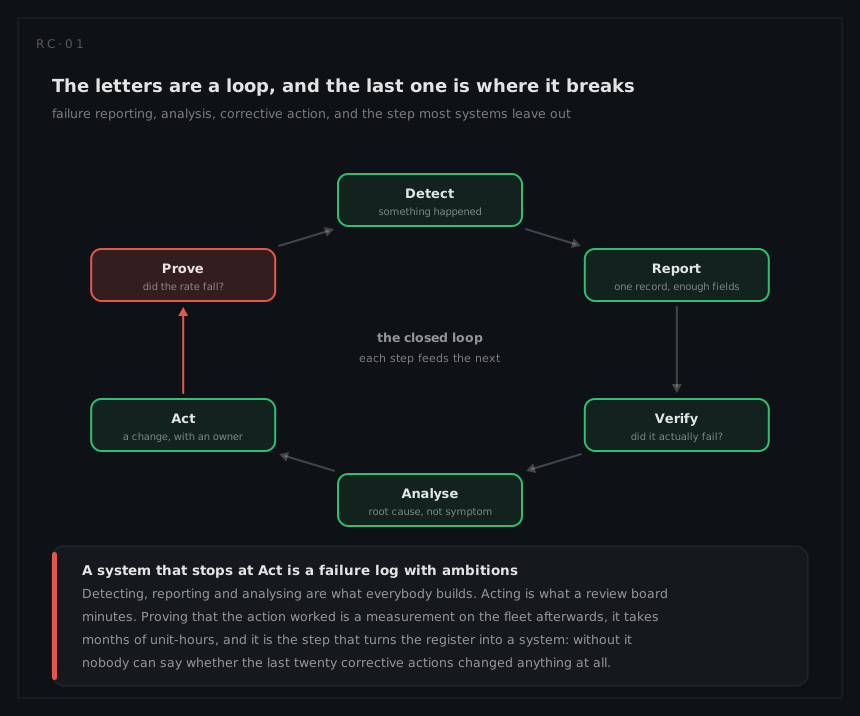
| Step | What it means | What goes wrong |
|---|---|---|
| Detect | Something happened, and somebody noticed | Failures that nobody reports because reporting is slow |
| Report | One record, with enough fields to be analysable later | Free text, no operating hours, no configuration |
| Verify | Did the item actually fail, and how | No fault found, counted as a failure or discarded silently |
| Analyse | The root cause, not the symptom | The Pareto chart mistaken for the analysis |
| Act | A change with an owner and a date | An action that is a note to be careful |
| Prove | The rate afterwards, measured | Skipped, so the loop never closes |
Where the discipline comes from
MIL-STD-2155 established FRACAS as a required system rather than a habit: a closed loop with defined states, a failure review board with the authority to direct action, and the requirement that corrective actions be verified rather than asserted. MIL-HDBK-2155 carries the guidance that replaced it. MIL-STD-785B puts the same thing in a reliability programme as a task in its own right, alongside the failure review board.
On the international side, IEC 60300-3-2 is about the collection of dependability data from the field: what a record has to contain, how operating time is accounted for, and the classification rules without which two organisations' failure rates are not comparable. That last point is the one this module spends most of its arithmetic on.
| Programme stage | What FRACAS is doing |
|---|---|
| Development test | Test-analyse-and-fix: the loop running fast, feeding reliability growth |
| Qualification | Every test failure classified and dispositioned; the evidence a review needs |
| Early service | The first real grades on the prediction, the mode ratios and the diagnostics |
| Mature service | Trend detection, recurrence control, and the data that makes the next design's prediction honest |
What it corrects
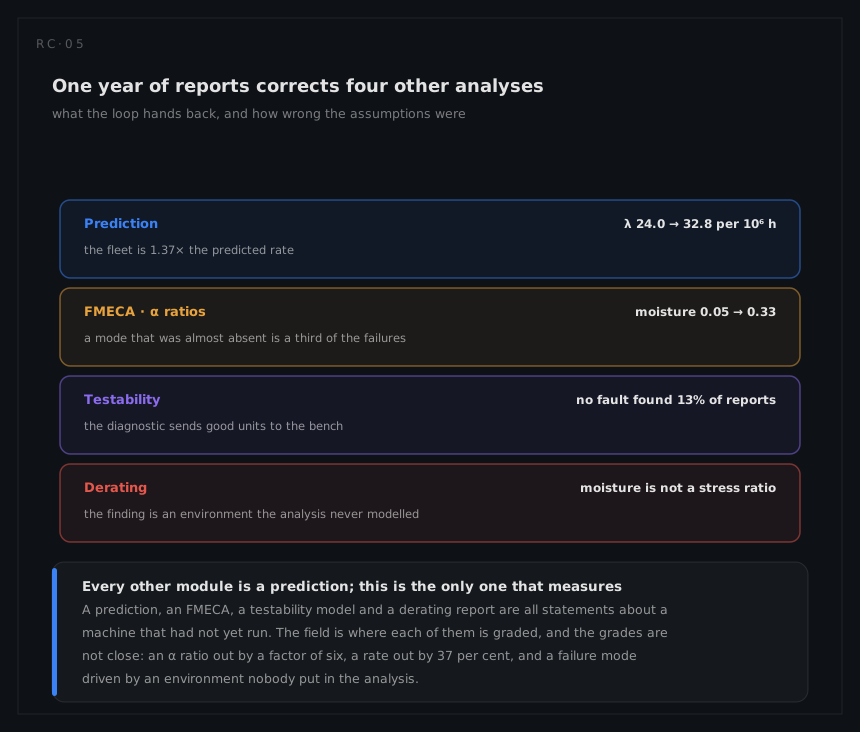
The loop's output is not a report. It is a set of corrections to documents that already exist:
| Analysis | What the field corrects |
|---|---|
| Prediction | The item rates, and the environment factor that was guessed |
| FMECA | The α mode ratios, and the modes nobody listed |
| Testability | The false alarm rate and the no-fault-found share, which only the field can measure |
| Maintainability | The task times, against a technician who was hurried and cold |
| Derating | Overstress found in service, and the environments the analysis never had |
| RBD and FTA | Block and event rates, and any common cause that actually happened |