

Derating is the most mechanical analysis in the set and the easiest to perform meaninglessly. Its whole difficulty is in two places: getting a real temperature for every part, and getting the worst case rather than the nominal one.
1. The rule set and the class are named once
The policy is one short document and it settles four things: which standard, which application class or quality level, what happens at a violation, and who may waive one. Everything downstream is arithmetic. A programme running to more than one standard, which happens when a subsystem is bought in, records which applies to which assembly rather than merging the two.
2. Build the parts list from the structure that already exists
The same list the prediction uses, so the two analyses cannot drift. Each line needs its ratings from the datasheet, in the same units the rule set uses, and its part family, which is what selects the rule.
3. Get the applied stresses
From the circuit analysis at the worst-case operating condition, not the nominal one: maximum line voltage, maximum load, end-of-life tolerance, the hottest environment the equipment is qualified for. Derating at nominal is the single most common way to produce a clean report on a board that will fail.
| Stress | Where the worst case usually is |
|---|---|
| Voltage | Maximum line, minimum load, transient recovery |
| Current | Maximum load, minimum line (for a converter), inrush excluded and analysed separately |
| Power | Both extremes: a linear regulator dissipates most at maximum line |
| Temperature | Hottest qualified ambient, end-of-life thermal interface, worst attitude for a spacecraft |
4. Get a temperature for every part
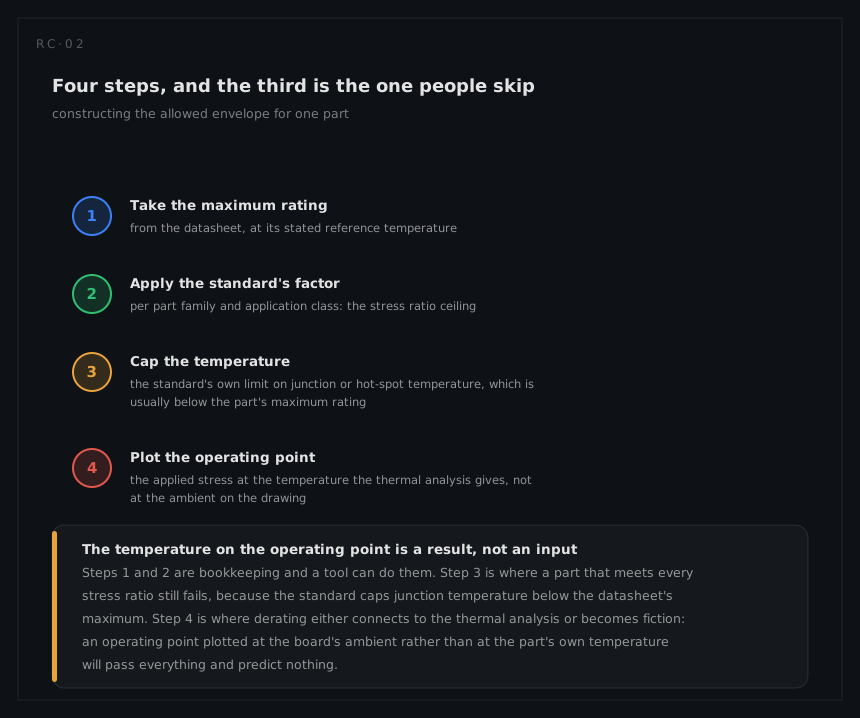
This is the step that separates a derating analysis from a spreadsheet. Each part needs its own temperature, from a thermal model, a thermal test, or a defensible hand calculation:
TJ = Tambient + θJA · P for a part in still air, or TC + θJC · P where the case is characterised
and the ambient in that expression is the local one inside the enclosure, above the hot component next to it, not the specification's outside air. Where the thermal model does not yet exist, the honest treatment is to record the assumption and flag the line, not to substitute the board ambient and move on.
5. Compute both checks, per part
For each stress type, the ratio against its ceiling; and separately, the part's temperature against the family cap. A part passes only if every ratio passes and the temperature passes. The report carries all of it, because the margin on a passing part is as useful as the violation on a failing one.
6. Disposition every violation
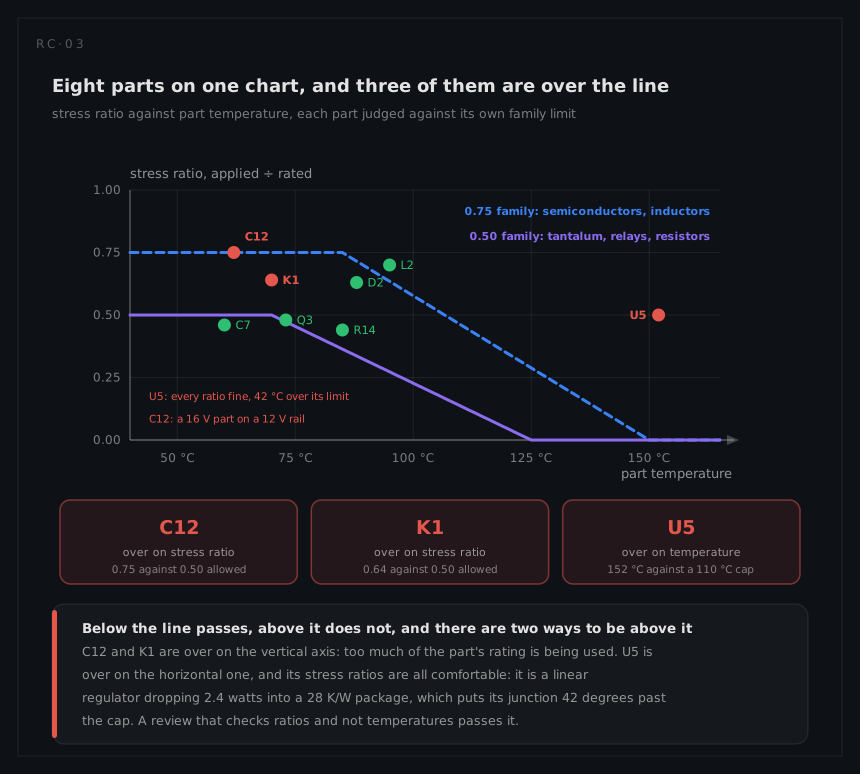
A violation has four honest outcomes, and "it is only slightly over" is not one of them:
| Disposition | What it means |
|---|---|
| Change the part | A higher rating, a better package, a different family. Cheapest before layout freeze |
| Change the circuit | Share the load, drop the voltage, switch instead of dissipate |
| Change the thermal design | Copper, a via field, a conduction path, a different position on the board |
| Waive it | Named authority, recorded rationale, and an entry in the FMECA for the overstress mode it makes credible |
The fourth is legitimate and is abused. A waiver resting on acceptable engineering judgement is not a disposition; one that says which mechanism was considered, what the margin actually is, and what evidence supports it, is.
7. Feed the result back into the prediction
The operating point that came out of step 5 is exactly what the prediction's stress and temperature factors need, so the two analyses close a loop: derating changes the operating point, the prediction prices it, and the price justifies the change. A programme that runs them in one direction only is doing half of each.
8. Re-run on change, and on every thermal revision
The parts do not move; the operating points do. A duty-cycle change, a new worst-case ambient, an added load on a shared regulator, a revised thermal interface: each of them moves temperatures across a whole board, and a derating report is only current until one of them lands.