

Every other analysis in this knowledgebase starts from a number that somebody had to produce. A prediction gives an item a failure rate; an RBD needs to know which failures stop the system; a fault tree needs a probability for each basic event; a diagnostic argument needs to know what the test is looking for. All four are asking the same question, and FMECA is the analysis that answers it: what are the ways this thing fails, what happens when it does, and how much of its failure rate belongs to each way.
The letters are two analyses stacked. FMEA asks what fails and what follows: for every item, every failure mode, and for every mode the effect locally, at the next level up, and at the system boundary, along with how the failure is detected and what compensates for it. Add criticality to that and it becomes FMECA: each mode carries a share of its item's failure rate and a probability that it produces the effect claimed, and the product ranks the worksheet.
The order matters and is often reversed in practice. Severity is a judgement about consequence that needs no rate at all, which is why it can be settled early and survives every later change to the numbers. Criticality then weights that judgement by how often the mode occurs. A worksheet with criticality numbers and unexamined end effects is precise about the wrong thing.
What it is and why it exists
MIL-STD-1629A, Procedures for Performing a Failure Mode, Effects and Criticality Analysis, issued 24 November 1980, is where the discipline's grammar comes from: the worksheet columns, the four severity classes, the indenture-level coding, and the criticality arithmetic that this module works through. It defines the analysis as four tasks, of which the first two are the analysis proper and the other two are what you do with it afterwards.
| Task | What it produces |
|---|---|
| 101 · FMEA | Modes, causes, the three levels of effect, detection method, compensating provisions, severity class |
| 102 · Criticality analysis | Cm = β·α·λp·t per mode, Cr per item, and the criticality matrix |
| 103 · FMECA-maintainability information | The same rows read for repair: what each mode costs to find, isolate and fix |
| 104 · Damage mode and effects analysis | The effects of damage from a stated threat, rather than of a random failure |
The technique is older than the standard. It came out of US aerospace and missile work in the 1950s and 60s, reached the civil world through the automotive industry, and now exists in three dialects that share a worksheet and disagree about the last column. IEC 60812 carries the international definition and treats criticality as one of several ways to prioritise. SAE J1739 and the AIAG-VDA FMEA Handbook carry the automotive line, where the ranking is by occurrence, severity and detection rather than by rate, and where the risk priority number was replaced by an action-priority table in 2019 for reasons the pitfalls chapter goes into. This module teaches the MIL-STD-1629A form, because it is the one whose output other analyses can consume.
Where it sits in the programme
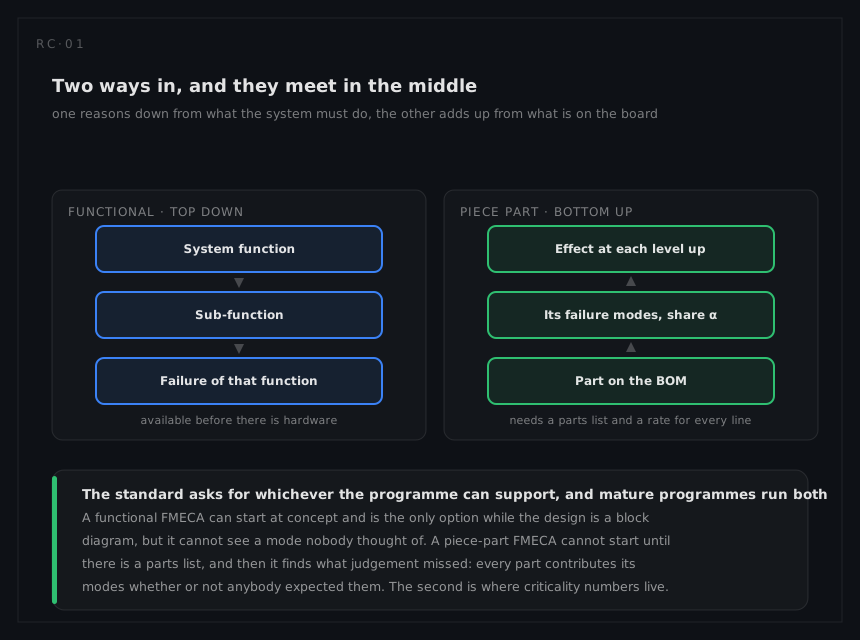
A functional FMECA can begin as soon as there is a functional breakdown, which is usually before there is a drawing. A piece-part FMECA begins when there is a parts list, and it is the version that feeds the rest of the programme, because a mode rate is what the other models actually consume.
| Programme stage | What the FMECA is |
|---|---|
| Concept | Functional, on the block diagram: which functions can fail, and how badly it matters |
| Preliminary design | Piece-part where the design is settled, functional where it is not; severity classes agreed |
| Detailed design | Piece-part throughout, with α and λp from the prediction and criticality computed |
| Verification and service | Re-run against test findings and field returns; the α ratios are the first thing real data corrects |
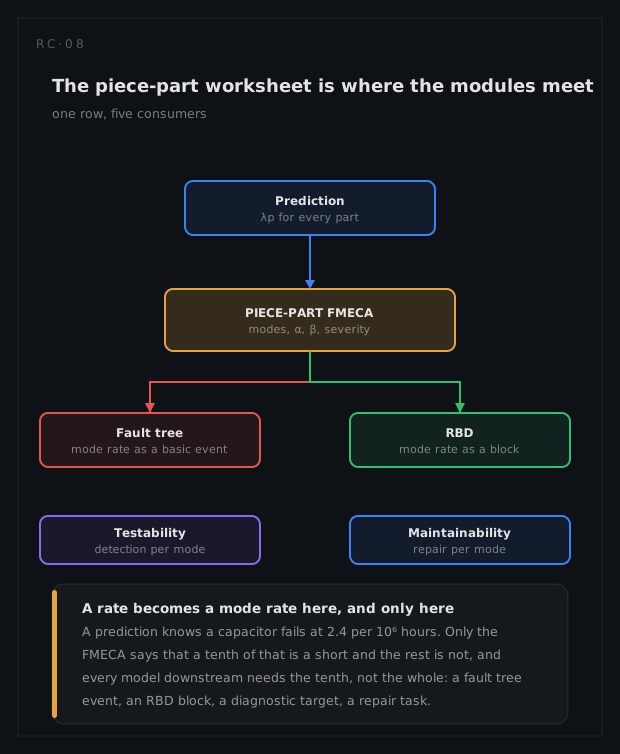
Downstream, the worksheet is the most widely read artefact a reliability group produces. Safety takes the severity classes and the single-point failures. A fault tree takes mode rates as basic events, and its top event is usually one of the end effects in this worksheet. An RBD takes mode rates where a mode rather than an item defeats a path. Testability takes the detection column and turns it into fault detection and isolation figures. Maintainability takes Task 103 and turns it into repair times and task lists.
How RAMSynapse approaches this
The FMECA module is a live worksheet on the shared product structure rather than a spreadsheet beside it. Items come from the BOM, so a piece-part analysis is generated from the same tree the prediction runs on and each item arrives carrying its predicted failure rate. The worksheet is hierarchical in the way the analysis is: an item has failure modes, and a mode has end effects, so one row is one mode-and-effect pair with its own ratings, grouped under its item.
Modes come from a failure modes library at project and company level, which is where the α ratios live: a proven mode with its distribution can be promoted to the company library and reused, which is how a fleet's own return data gradually replaces generic mode ratios. Ratings can be phase-dependent, because a mode that is catastrophic in one mission phase is often negligible in another, and the worksheet can be edited per phase or across all of them.
Task 102 computes the criticality contributions per mode and aggregates item criticality, and severity against probability places every mode on the project's risk matrix, whose thresholds come from a shared library rather than from each analyst. The grid is built for worksheets that run to thousands of rows: it is virtualised and saves row-by-row with per-row conflict protection, so several engineers work the same worksheet at once.
| Link on the live registry | What flows |
|---|---|
| Prediction → FMECA | Items generated from the BOM carry the element failure rate; α splits it into mode rates |
| FMECA → FTA | A mode rate becomes a basic event's probability |
| FMECA → RBD | A mode rate becomes a block's source, where a mode rather than an item defeats the path |
| FMECA → Testability | The detection column, per mode |
| FMECA → dashboards | The severity mix and the top-criticality items, on the project home page |