

Every property in this Concepts row eventually depends on a humbler question: when something inside the system breaks, does anything know? Testability is the design property that answers it, and its sequel: how precisely can the failure be located? A system with poor testability can be reliable on paper and chaotic in service, because every failure becomes an investigation; a system with excellent testability turns the same failures into queries: the fault announces itself, names its replaceable unit, and the repair is a swap.
Testability is the least glamorous member of the RAMS family and arguably its highest-leverage multiplier. It does not make failures rarer or repairs physically faster; it removes the not knowing from both ledgers: the diagnosis hours that dominate corrective maintenance in electronics-dense systems, and the silent, undetected failures that quietly corrupt availability and safety arithmetic. This topic covers the property end to end: the coverage mathematics, built-in test and its false-alarm economics, how coverage rolls up and where undetected failures go, and the design and programme machinery that builds diagnosis in.
What testability is
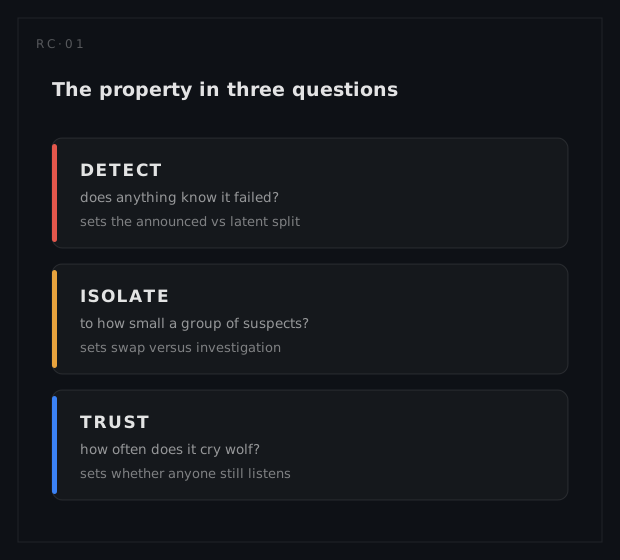
The working definition, in the spirit of the US testability handbook lineage (MIL-HDBK-2165) and the IEC maintainability series (IEC 60706-5): testability is the design characteristic that allows an item's status to be determined (operable, inoperable, degraded) and its faults to be located in a timely and confident manner. Three questions unpack it:
| Question | The measure family | What it decides |
|---|---|---|
| Does anything detect the failure? | Fault detection rate | Whether the failure is announced, or waits silently for a demand, a test, or a bigger event |
| How tightly is it isolated? | Fault isolation rate, ambiguity group size | Whether the repair is a swap or an experiment on a group of suspects |
| Can the answers be trusted? | False alarm, cannot-duplicate and retest-OK rates | Whether crews act on the built-in test, or learn to ignore it |
The third question earns its seat at the table because the first two can be gamed against it: a test set that flags everything achieves superb detection coverage and destroys its own credibility. Real testability is the joint optimisation of all three, and the field measures of the third (the no-fault-found family) are where the joint failure shows up first.
Why it matters
Testability's value arrives through the other properties, which is why it is easy to underfund and expensive to have underfunded:
- It owns the front of every repair. In modern systems the diagnosis pair (localization plus isolation) commonly dominates corrective time; the maintainability foundations treat it as the first and heaviest task element. Isolation to one unit versus a three-unit ambiguity group is routinely the difference between a twenty-minute swap and an hour of swap-and-retest, multiplied across the fleet's life.
- It keeps availability arithmetic honest. Every undetected failure is hidden unavailability: a standby channel silently dead, a protective function that will not answer its demand. Detection converts the λT/2 latent ledger into the announced ledger where repairs can actually begin, and redundancy only delivers its q² magic while the second channel's health is genuinely known.
- It is a safety instrument. The dangerous failures that matter most are the ones that hide; fault-tree analyses of protective systems are, in large part, catalogues of what the built-in test does not see, and proof-test intervals exist precisely to cap the exposure.
- It carries brutal economics. Poor isolation manufactures no-fault-found removals: good units pulled on suspicion, shipped, retested, returned, while the real fault rides along. The NFF stream inflates spares budgets, clogs repair pipelines, and corrupts the field-failure data every other analysis feeds on. It is the single most visible symptom of a testability shortfall, and whole aerospace maintenance-cost studies have been written about it.
As with every property in this row, the asymmetry rule applies: coverage is decided when the monitors, test points, and partitioning are drawn, cheaply; it is paid for, or mourned, across decades of diagnosis.
Testability among R, A, M and S
Testability is the quartet's enabling layer rather than a fourth outcome: maintainability consumes its isolation resolution as the input to every repair-time number; availability consumes its detection split to decide which failures are announced and which go latent; safety consumes its blind spots as the starting inventory of hidden dangerous failures; and even reliability depends on it retrospectively, because field failure data is only as accurate as the diagnosis that generated it: an NFF-polluted FRACAS quietly miscalibrates the next generation of predictions. One property, four customers, which is why coverage targets deserve the same allocation-and-budget treatment as failure rates and repair times.
Where the discipline came from
Testability grew up inside military avionics, where dense electronics first made "which box?" the dominant maintenance question and built-in test (BIT) the first answer. The US formalised the discipline in the mid-1980s with MIL-STD-2165, which made testability a managed programme (requirements, allocation, prediction, demonstration) rather than a circuit-design afterthought; like its reliability and maintainability siblings, it was converted to guidance in the 1990s reform as MIL-HDBK-2165. In parallel, the electronics industry solved its own testability crisis at the board level: as packaging density made physical probing impossible, the boundary-scan architecture standardised as IEEE 1149.1 (JTAG) built test access into the silicon itself, one of the clearest examples in engineering of a testability feature becoming universal infrastructure. The IEC maintainability series carries the international design-guidance thread (IEC 60706-5, testability and diagnostic testing), and the modern extension of the discipline (prognostics and health management: predicting the failure before it happens, not just detecting it after) builds directly on the same monitors, coverage logic, and honesty measures this book covers. The chapters that follow take the mathematics first, then the system view, then the design and programme machinery, then the toolkit map.