

Testability's toolkit is compact, because the discipline has one central analysis (the dependency-model computation of coverage) and a ring of producers and consumers around it. The FMEA feeds it, the maintainability and availability analyses live off its outputs, and the field's no-fault-found record judges it. This chapter maps the ring: what each method answers, how the chain runs, where the RAMSynapse platform stands, and how the emphasis shifts across industries.
The testability toolkit
| Method | The question it answers | Typical phase | Read more |
|---|---|---|---|
| Testability Analysis | What does this design detect, and to what ambiguity does it isolate? | Design | Full topic published |
| FMECA | The input inventory: which modes exist, at what rates, with what effects | Design | Full topic published |
| Reliability Prediction | The weights: the λ behind every coverage percentage | Design | Full topic published |
| Maintainability Prediction | The first consumer: isolation resolution as the diagnosis-time input | Design | Full topic published |
| Fault Tree Analysis | The safety consumer: which undetected combinations defeat the protective functions | Design | Full topic published |
| RCM | The scheduled-maintenance consumer: failure-finding tasks for what BIT concedes | Design and operations | Full topic published |
| RBD / availability modelling | The availability consumer: detection intervals deciding latent exposure | Design | Full topic published |
| FRACAS | The judge: CND and RTOK rates against the claimed coverage | Field | Full topic published |
The pattern worth noticing: testability analysis is the only row that produces coverage; every other row either supplies its inputs or spends its outputs. That makes the dependency model one of the highest-traffic artefacts in the whole RAMS workflow, and its version discipline (against the FMEA revision, against the hardware configuration) a chain-integrity issue rather than a documentation nicety.
How the methods chain together
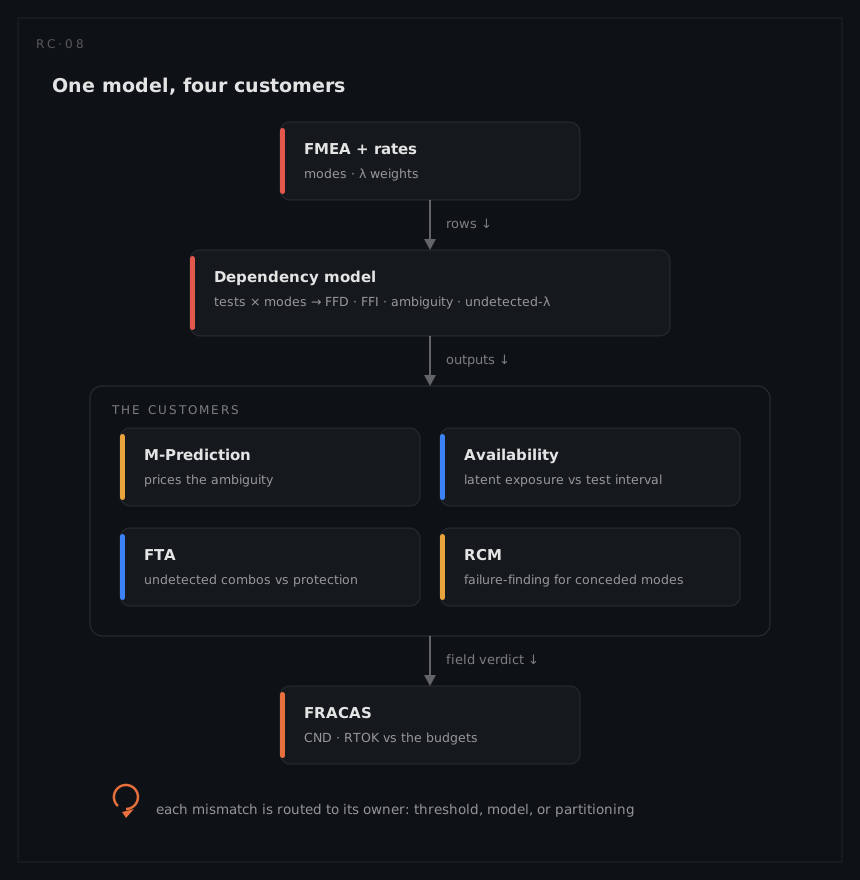
- The inventory flows in. The FMEA supplies the modes and effects; the prediction supplies the rates that weight every number. A censored or stale inventory silently censors the coverage claims built on it.
- The model computes. Testability analysis turns modes, tests, and their dependencies into detection coverage, isolation signatures, ambiguity groups, and the undetected-λ list, per unit and rolled up.
- The customers spend. Maintainability prediction converts ambiguity into diagnosis time; availability models convert the undetected fraction into latent exposure against test intervals; fault trees hunt the undetected combinations that disarm protection; RCM writes failure-finding tasks for the dormant modes the design conceded.
- The verdict returns. FRACAS brings back the field's answer: announced-failure share versus claimed FDR, first-swap success versus claimed FIR, and the CND/RTOK Pareto versus the false-alarm budget, each mismatch routed to its owner: threshold, model, or partitioning.
Where RAMSynapse runs it
Testability is one of the platform's built modules, and it sits exactly where this chapter's chain puts it: the Testability module computes fault detection and isolation coverage driven directly by the FMECA module's failure modes on the shared system model, so the modes-to-coverage handoff is a live link, with the failure rates arriving from Reliability Prediction upstream. The registry standard behind the module is the MIL-HDBK-2165 tradition this topic has followed throughout, and the live module ring shows the FMECA-to-Testability flow among the platform's running links. In the product the picture is narrower than this chapter's chain: the registry's only edge into or out of Testability is that FMECA feed, so the coverage figures are read in the module rather than piped onward. The Fault Tree module is built and quantifies on the shared failure rates, but it takes them from the reliability and FMECA chain rather than from Testability. Reading coverage across into those analyses is an engineer's job rather than a link.
Industry lenses
| Industry | What testability work typically looks like |
|---|---|
| Defence and aerospace | Contractual FDR/FIR and false-alarm requirements, BIT-heavy avionics, fault-insertion demonstrations, NFF cost campaigns |
| Space systems | Telemetry as the only test access there will ever be: observability designed for diagnosis from the ground, health management as survival |
| Railway | Trackside and on-board diagnostics feeding maintenance regimes; failure-finding checks on safety functions inside the EN 50126 frame |
| Automotive | On-board diagnostics as regulated infrastructure: standardised fault codes, freeze-frame data, dealer-level isolation at fleet scale |
| Energy and resources | Condition monitoring as the testability layer of rotating plant; proof-test coverage of trip functions under functional-safety rules |
| Medical devices | Power-up self-test as a release-to-use gate; service diagnostics constrained by who may open the device |
| Electronics and high tech | Boundary scan and built-in self-test as manufacturing economics; the RTOK problem industrialised as reverse-logistics screening |
| Nuclear | Surveillance test programmes as the availability instrument of protection systems; test intervals justified in the PFD ledger |
Across all eight the constant is the pairing this topic began with: detection and isolation buy their value in someone else's ledger (repair hours, latent risk, spares churn), and the sectors differ mainly in which ledger hurts most. That is also the practical reason testability budgets survive: not because coverage is admired, but because the NFF stream, the latent-failure audit, or the diagnosis hours eventually present the bill with interest.